
Part 3 of a 3-part ISAP series on biofuel carbon intensity for Illinois corn and soybean farmers
By Bonnie McGill, Jean Brokish, and Ben Wiercinski (American Farmland Trust)
This series of blog posts explains what is known and unknown regarding CI scores for corn and soybean farmers. This series pulls from our conversations with several experts, the latest government rules and tools, and the literature. We hope it helps bring you up to speed on CI scores and what questions we all need to keep asking.
How a farmer’s crop CI score affects the amount of their payment from the buyer is not clear. The IRS tax credit goes to biofuel plants–not farmers. The payment to farmers will be less than the face value of the tax credit because of several transactions along the value chain from plant to farmer (Figure 1, below). Plants will typically sell these clean energy tax credits in a transfer market where credits are sold to taxpayers at a discount. Plants will usually buy tax credit insurance to protect buyers in case the IRS challenges the validity of their 45Z credits. Each entity in the supply chain also has reporting and verification responsibilities that cost money to operate.
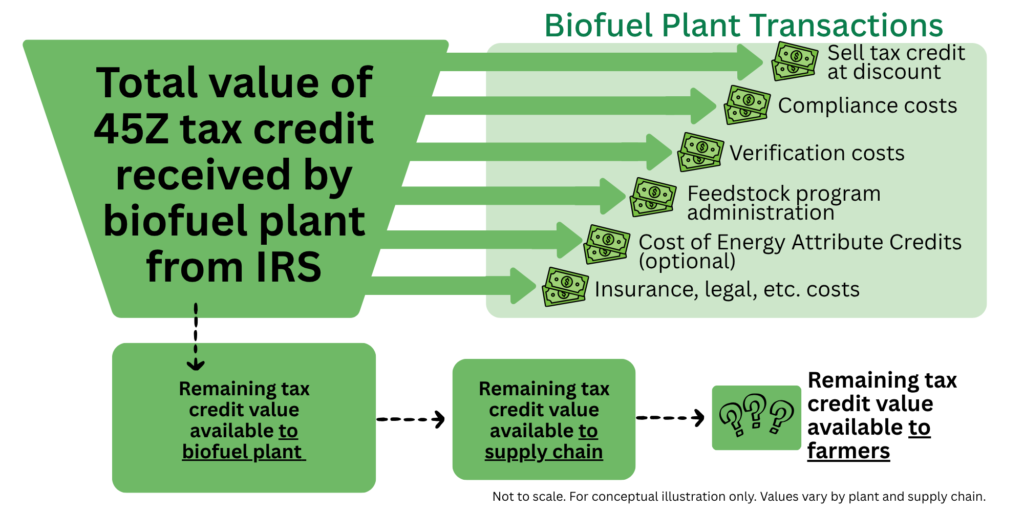
Figure 1. The difference between the 45Z tax credit to the biofuel plant and what might remain for farmers selling biofuel crops into the feedstock supply chain. Based on this incite.ag blog post by Preston Brown with permission.
So any potential payment that passes from the biofuel plant to the farmer is unknown, because payments will be decided by each biofuel plant and entity in the supply chain. Any payments will likely vary greatly by crop because of their different CI score potentials as explained above. Corn passes through fewer entities between a farmer and an ethanol plant, whereas soybeans pass through many hands requiring any CI score payment to also change hands, with each middleman potentially claiming a portion of that payment. Ultimately, the rule leaves it up to each plant and their supply chain to determine how much, if any, incentive payment goes to farmers. This is a major difference compared to “pay for practice” programs like EQIP or environmental market programs that pay farmers per ton CO2e avoided or removed.
Additionally, biofuel plants can also choose how to average the wide range of CI scores from their many producers. They could apply one average incentive payment rate per bushel to all farmers, or the incentives could be tiered by a farmer’s CI score.
CI score tax credit payment rates from the IRS to biofuel plants are tiered by increments of 10-15 kg CO2e per mmBTU of their biofuel. A biofuel producer only qualifies for a higher credit per gallon of biofuel by lowering their CI score into a whole new tier. In theory, this means that a biofuel producer that is close to moving into the next lower CI score tier would pay a higher incentive rate than a biofuel producer who is at the higher end of a tier. How this actually plays out is still unclear.
What to ask
Farmers may wish to ask the following questions of their nearest biofuel feedstock buyer (an elevator, an ethanol plant, etc.).
- How will I be compensated for contributing to a biofuel plant’s 45Z tax credit payment? Further, is compensation calculated by farmer or is it an average among farmers with different CI scores? Without this information it may be hard to decide if implementing a new low-carbon practice will pay off at the farm level. If enough farmers ask these questions, it will encourage greater transparency from buyers.
- How will you collect my Biofuel Feedstock Report? This will help you correctly prepare and submit your report (what the Report must include § 2100.031(e)) in paper or electronic form. The buyer may also provide guidance on what records you are required to keep in case you are audited by their third party verifier.
What comes next
Now that the USDA has finalized its Regenerative Feedstock Rule, two more things need to happen in order for low-CI feedstocks to be applied to 45Z. One occurred in September: the US Department of Energy incorporated USDA Feedstock CI Calculator as a module in the tool used to estimate biofuel plant emissions, called 45ZCF-GREET. The third and final remaining piece we’re waiting for is the US Department of the Treasury to incorporate USDA’s Final Rule within the 45Z code.
What you can do: Connect with ISAP to learn more. Get the latest updates by subscribing to The Aggregate, ISAP’s monthly e-newsletter. Also check out ISAP’s resources for producers at any step in their soil health journey, including adopting the low-carbon practices discussed here.
Learn more
- Biofuel Carbon Intensity Scores: Knowns and unknowns for Illinois corn and soybean producers (the full report)
- Part 1: What is a CI score and why do corn and soybeans have different scores?
- Part 2: What is known about CI scores and how farmers can get involved
- USDA Final Rule on Technical Guidelines for the Production of Regenerative Agricultural Biofuel Feedstocks (June 2026) – this page includes an informative webinar recording from USDA explaining the Final Rule
- USDA Feedstock CI Calculator (FD-CIC) – excel spreadsheet and web app versions available here.
- USDA Tillage Disturbance Calculator (T-DISC) – excel spreadsheet and web app versions available here.
- The Section 45Z Clean Fuel Production Credit – a report by the Congressional Research Service (Feb. 2025)
- American Soybean Association A Look at Potential Soybean Farmer Premiums with 45Z
- Illinois Corn Growers What Illinois Corn Farmers Need to Know About 45Z
- incite.ag The Economics Behind 45Z Feedstock Value
We made this report because 45Z exists and some Illinois producers can take advantage of it, but we’re not endorsing 45Z as a solution for all farmers.
We thank the following reviewers:
Talon Becker, PhD, CCA (University of Illinois Urbana-Champaign Extension)
Preston Brown (incite.ag)
Megan Dwyer, CCA (IL Corn)
Dr. Scott Gerlt (American Soybean Association)
David Kubik (Illinois Soybean Association)
Casey Kula (American Farmland Trust)
