
Ag retail is an integral part of the local agriculture supply chain, providing the products, services, and advice that farming operations rely on. Given this relationship, ag retailers can be an incredible ally in conservation efforts, but it’s important for conservation ag professionals to understand how and when to bring them into a project and how best to support them. A core pillar of The Nature Conservancy’s (TNC) row crop agriculture strategy is working with ag retailers and other farmer advisors, and TNC has spent the last few years engaged with them in the Lake Decatur NRCS Regional Conservation Partnership Program (RCPP) grant. Here are some of TNC’s key observations from their work with ag retailers in the RCPP.
RCPP Background and Results
The Lake Decatur RCPP is a 5-year, $9.8 million dollar USDA-NRCS grant intended to protect and improve the waters of Lake Decatur, which serves as the water source for the residents and businesses of Decatur, IL. The grant is primarily focused on practices that reduce sediment, but nitrate is also a target. Producers were eligible for a mix of in-field and edge of field practices at cost share rates of 100% compared to NRCS’s standard of 75%.
Integral to the program was the formation of the Lake Decatur RCPP Advisory Board, which continues to help guide program efforts. The board is composed of a diverse group of local ag stakeholders including those with roles as farmers, ag retailers, conservation organizations, farm managers, and lake management employees. The board was crucial in farmer enrollment, outreach/education events, and troubleshooting issues in sign-ups, implementation and partner commitments.
The RCPP committed nearly all its money in the first season of applications and will fund 37,000 acres of cover crops, 26,000 acres of no-till/reduced till, and 33,000 acres of nutrient management. Approximately 30 farmers will be funded over the project’s 5-year span.
The Six Steps of Successful Ag Retail Engagement
Ag retail engagement began relatively early in the grant implementation process and was crucial to the success of the grant. One specific ag retailer was fully invested, serving not only on the board, but also as a recruiter with his customers. He was so committed to outreach, that approximately 50% of the applicants were his customers. Despite that overwhelming success, grant team also found significant areas of improvement in how and when they could have engaged with ag retailers during the grant. What follows is a playbook and timeline on how to engage with ag retailers during a large regional conservation funding program.
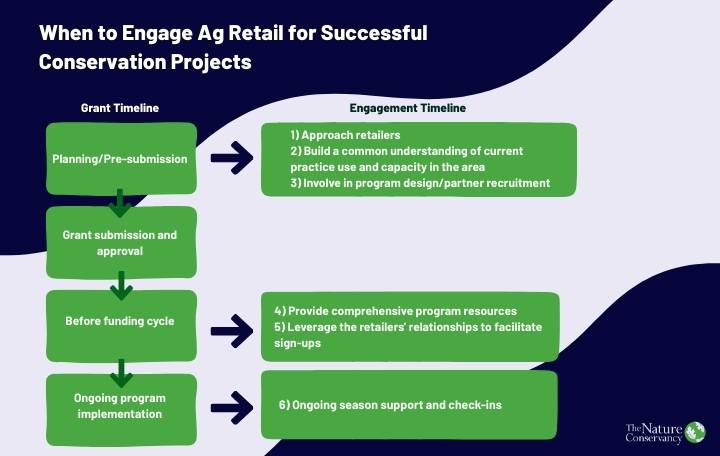
The graphic above will help visualize how the following engagement steps line up with grant timeline milestones.
Step 1: Approach Ag Retailers in the Grant Planning Stages
Ag retailers will be responsible for much of the application and management of in-field practices. Before designing a project, meet with local ag retailers to gain an understanding of the local ag landscape, trying to answer questions such as:
- What does the local ag retail landscape look like?
- How many local ag retail companies are there?
- Are they local, regional, or national companies?
- What are the inter-company relationships?
- Would competing companies collaborate, serve on project boards, etc.?
- What are their current capabilities/offerings for planned practices? And what would they need to increase their offerings or capacity?
- What do they feel appropriate goals are for various practices, and what price point is needed to interest farmers?
Ultimately try to identify at least one candidate to be a local champion for the project and serve on a project advisory board. In TNC’s grant experience, most retail engagement began after the project was funded, approximately nine to 12 months before funding was set to begin, but they still did the above assessment. The team reached out to every ag retail operation either inside the target region, or within 15 miles. There was a mix of small, local companies, regional companies, and national chains. Based on the original contact with 10 retail locations, six showed little to no interest, three were mildly interested and participated in customer outreach events, and one played an active role in the board and recruitment.
In this specific case, since farmer outreach preceded ag retailer outreach, part of their ag retailer outreach strategy involved using interested farmers to draw in retailers. The team surveyed interested farmers to generate a list of their primary retailers. This allowed the team to contact a retailer and say “We spoke to X farmers that expressed interest in the RCPP and implementing X practices and they mentioned you were their primary retailer. Would you be interested in…”. This allowed the group to suggest an initial meeting with grant managers to learn more, schedule a farmer informational meeting and more since the retailer already had customers interested in the program.
Step 2: Build a Common Understanding of Current Practice Use and Capacity
Working through conflicts of interest and misconceptions is the cost of working with any partner in a project. After assessing products and services offered by local advisors, list the priority practices for the program and if partners are incentivized to push farmers in other directions. For example, most of the issues TNC ran into involved nutrient management plans. While they certainly wanted to reduce nitrate levels entering the lake, the primary focus of the RCPP is to reduce lake sedimentation rates. Because there was a limited practice budget, the preference is for more dollars to be spent on the most impactful erosion reducing practices, like reduced tillage and cover crops. Despite this, ag retail is understandably incentivized to provide nutrient management services as it’s more in their realm of expertise and a higher margin business than providing tillage- and cover crop-related services. Knowing which partners are best suited for which practices can help inform project design and budgets.
Additionally, TNC ran into misconceptions on what advisors considered a nutrient management plan. For the purposes of the grant, the nutrient management plan needs to be created by NRCS or a certified Technical Service Provider and follow specific NRCS formatting and conservation rules. Ag retailers and independent advisors frequently make fertilizer plans for customers, but these are rarely the same product, so they cannot be funded by NRCS. Similarly, NRCS has specific guidelines on cover crop and reduced tillage implementation. Ensuring that retailers understand the rules of implementation early can help avoid serious issues at cost share reimbursement time.
Lastly, use ag retailer engagement to find your own misconceptions. One of the grant features was extensive mapping of local practices and modeling of high-impact fields. With this data, grant facilitators were able to better direct grant dollars to the highest impact areas. In early practice mapping, modelers saw fall strips and assumed fall strip-till was a common practice. Instead, strips were actually fall anhydrous applications. An early conversation with ag retailers about standard practices in the area would have caught this misunderstanding.
Step 3: Get Them Involved in Program Design and Partner Recruitment
As mentioned, ag retailers only took a meaningful role after the project was designed and funded. Additionally, ag retailers were not involved with grant partner recruitment. Official grant partners are important providers of matching funds, labor, products or services that help facilitate grant success. The team especially felt a gap in partners that could have supported ag retail’s efforts in in-field conservation implementation. In a region of generally low conservation adoption, availability of equipment is similarly low. Farmers may occasionally have a piece of equipment suited for cover crop application, but it’s unlikely a retailer has a low utilization service or piece of equipment sitting around waiting for a regional funding opportunity. Therefore, it would have been helpful to use gaps in retail services to drive partner contributions.
The most significant example was an equipment dealership’s partner contribution of a large tractor for use in the watershed. Ironically, the ag retail partners have several large tractors already available. The actual need was for an implement. A cover crop drill or strip-till rig would have been far more useful in the watershed as retailer’s ability to provide the core services of the grant was significantly limited in a region where such practices are not the norm. Rather than a diverse line up of application types, cover crop planting was limited to aerial or broadcast with fertilizer, and strip-till was not an option. Understanding the limitations of the group that are ultimately responsible for most of the implementation and management of the program is crucial for success.
Step 4: Provide Comprehensive Program Resources
Ag practice implementation in a conservation program can be complicated. Not only is the farmer and advisor potentially experimenting with a new management system, implementation needs to be program compliant to qualify for reimbursement. Once a decision is implemented, it is often hard or impossible to change course. For example, cover crops must be planted using the right rate that takes into account seed purity and germination rates and application method, by a date that changes by county. Given that the team was potentially dealing with several different implementation plans, multiple cover crop/application possibilities, and multiple counties, TNC created practice guides to ensure mistakes were kept to a minimum. The cover crop guide walks growers and advisors through all the things needed to know before planting cover crops in the RCPP, including:
- Payment Rates for different implementations (winter-kill, over-wintering, single/multi-species)
- A summary chart with a handful of suggested beginner species, listing rate by application method and date by county
- Example walkthroughs that explain NRCS compliant scenarios that a grower would consider, including economics and management
Using the cover crop guide, a grower could see how to manage a cereal rye cover crop before soybeans, what chemicals to terminate with, how to handle a small vs. large cover crop, and the economics of a single vs. multi-species mix.
Similarly, TNC also created an informational guide on reduced tillage. Rather than run complicated NRCS calculations on tillage system intensity, they created a derivative calculation system based on local tillage tools and a simplified point system that farmers could use to mix and match tillage passes to understand if a desired system would likely qualify for reduced tillage before confirming with NRCS.
Step 5: Leverage Ag Retailer Relationships to Facilitate Sign-ups
As mentioned, the project had one ag retail partner fully committed to the program given the potential for local impact and value for his customers. A very effective farmer recruitment method was for him to invite interested customers to his office for individual meetings with the watershed management city employees managing the grant. These three-way meetings provided a space for collaboration where the three parties could answer any implementation, management, or administrative question, all while filling out the program application.
Step 6: Ongoing Seasonal Support and Check-ins
Once applicants were funded, the group used the retailer as the main point of contact for implementation. Oftentimes beginners are relying entirely on the ag retailer for sourcing seed, application, and termination. While farmer participants are regularly contacted, it’s important to efficiently check in and disseminate management information using the ag retailer. We try to make timely touchpoints with the ag retailer that make sense for the seasonal management cycle:
- Summer: Ideal time for ag retailers/farmers to assess success of current season management, make next season adjustment plans, and begin sourcing cover crop seed
- Fall: Confirm planned timing, species, rates with management considerations given current conditions, like adapting application method for drought conditions
- Spring: Confirm management based on field/weather conditions. Is the chemical plan appropriate? Will growers need to plant green vs. terminate early given cover crop height? Is the weather warm enough for successful termination?
Ag retail is a crucial part of the ag production system and essential to the success of any local conservation project. They are local management experts with deep connections and credibility in the farmer community. While many retail locations may not be set up to offer customers a full suite of conservation practices, they can be adaptable and open to change given the opportunities that conservation funding brings to their customers and local resource concerns. To maximize success, TNC’s experience shows that ag retailers should be among the first local contact points during project planning and remain closely involved through implementation.
If you’re planning or currently administering a conservation program in an area and want to talk about ag retail engagement strategies and opportunities, feel free to reach out to Frank Rademacher, IL Conservation Agronomist at frank.rademacher@tnc.org
