
As spring approaches, many in the Illinois ag community are thinking about soil moisture, or lack thereof, with approximately two-thirds of the state under moderate to severe drought conditions as of February 3. Although we still have at least a couple months for spring rains to come before most farmers in the state will be thinking about planting, current conditions are also raising concerns for the potential of wind erosion in farm fields and a recurrence of the dust storms that have affected the state in recent years. When these dust storms occur, wind erosion becomes more than just an agronomic issue of lost fertility and soil health; it becomes a public health issue.
With dust storms in the public eye, tillage and cover crop practices are also being scrutinized for their return on investment to the farmer. While there are clear ecosystem and soil benefits that come with the use of reduced tillage and cover crop systems, farmers cite residue management as a primary reason for being hesitant to adopt or moving away from these systems. Some of the challenges that come with increased plant residue from reduced tillage and cover crop systems include planting difficulties due to residue interference with the planter, slower soil warming/drying in early spring, and lower early-season nutrient availability.
As farmers try to optimize management to maximize profitability, efficient nutrient management is essential. But questions remain about how tillage and cover crop practices influence economic optimum nutrient management practices. Recent work by Dr. Giovani Preza Fontes and his collaborators, with funding from the Illinois Soybean Association, investigates this interaction between tillage system and nutrient management practices in soybeans, attempting to provide some direction for farmers interested in optimizing their management and integrating conservation practices to maximize profitability.
In this ongoing project, Dr. Preza Fontes and collaborators conducted research trials across the northern half of Illinois and the eastern half of Iowa during the 2024 and 2025 growing seasons. These trials examine the impact of different tillage systems (conventional 2-pass [fall chisel + spring cultivator], strip-till [fall], and no-till) as well as the inclusion of a cereal rye cover crop with the no-till system in combination with different nutrient management practices (unfertilized, 15 lbs N/ac [UAN], and 15 lbs N/ac + 10 lbs S/ac [UAN + ATS]) on soybean growth and yield.
Results from the 6 site-years of trials conducted thus far show that although tillage and starter fertilizer often translate to increased early season soybean biomass (Fig. 1), this does not necessarily translate to increased yields at the end of the season (Fig. 2).
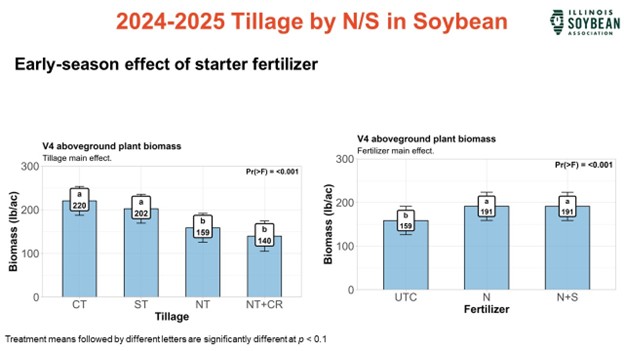
Figure 1. Soybean biomass at V4 under different tillage/cover crop systems and starter fertilizer regimens averaged across six site-years in Illinois and Iowa. Alt Text: Bar chart showing the relationship between tillage and starter fertilizer on early season (V4) biomass accumulation in soybeans grown in northern Illinois and eastern Iowa. The results show decreasing biomass with decreasing tillage, as well as with the inclusion of a cereal rye cover crop prior to soybean planting. The addition of starter nitrogen fertilizer did increase early season (V4) soybean biomass, but no additional effect was seen from the inclusion of sulfur fertilizer.
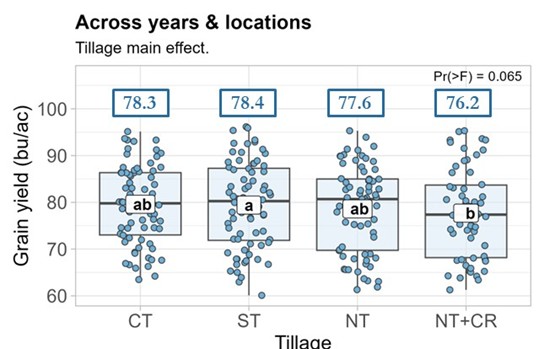
Figure 2. Soybean yields under different tillage/cover crop systems across six site-years in Illinois and Iowa. The numbers above each boxplot indicate the average yield for each treatment. Alt Text: Box plot showing the relationship between tillage/cover crop system and soybean yields averaged across site-years. The results show no statistically significant effect on yield from reduced tillage. But the inclusion of cereal rye in the no-till system did significantly reduce yields as compared to the strip-till system (2.2 bu/ac).
Furthermore, although starter nitrogen fertilizer had a significant effect on early-season soybean biomass, this did not translate into differences in plant tissue nitrogen concentration during flowering (Fig. 3) or final yields (data not shown).
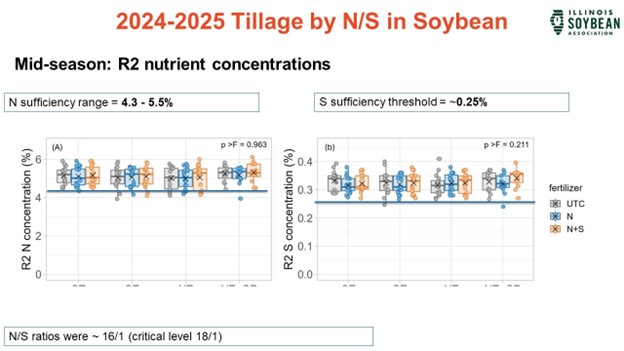
Figure 3. Concentration of nitrogen and sulfur in upper canopy leaf tissue of soybeans under different tillage/cover crop systems and starter fertilizer regimens. Alt Text: Box plot showing the relationship between tillage/cover crop system and starter fertilizer on the concentration of nitrogen and sulfur in soybean leaf tissue. The results show that neither tillage/cover crop system nor starter fertilizer treatments impacted leaf tissue concentrations of these elements.
In thinking through the economics and return on investment to these practices, the research referenced above clearly shows that reduced tillage does not necessarily lead to significantly reduced yields and profitability. In fact, with the rising costs associated with tillage practices and stagnant crop prices, the yield benefit from tillage operations must be significant to offset the cost of the tillage. Using a conservative cost estimate of $34.80/acre for conventional tillage and $26.10/acre for strip tillage, along with average yields from the six site-years of the trial, Dr. Preza Fontes and collaborators found no-till soybeans to be the most profitable system, with a partial net return of $853.60/acre compared to $836.30/acre for strip-till, $826.50/acre for conventional till, and $783.20/acre for no-till plus a cereal rye cover crop. Regarding nutrient management, at least at the sites used in this study, it is clear that starter fertilizer for soybeans doesn’t “pay for itself”. Yet, every field is different, and farmers may find benefit in using reference strips (aka check strips) in their fields when testing out a new practice. These strips should be randomly placed throughout the field to ensure fair comparisons; one strip is never enough. In general, fields with lower organic matter (<2%) are more likely to show sulfur deficiencies and may be targets for farmer experimentation with starter fertilizer.
Illinois Extension faculty and staff are available to consult with farmers interested in conducting their own on-farm trials. For a consultation, please reach out to your local ag Extension Educator, Specialist, or the authors of this article (Giovani Preza Fontes – giovani3@illinois.edu; Talon Becker – tbecker2@illinois.edu).
