
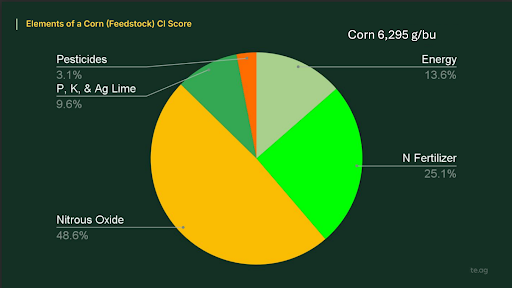
Estimated contributions to carbon intensity of corn (Image credit: Preston Brown, incite.ag)
What is carbon intensity and what does it mean for crop producers in Illinois? This January 2026, the Illinois Sustainable Ag Partnership Science Committee was joined by Megan Dwyer, Director of Conservation and Nutrient Stewardship at the Illinois Corn Growers Association and Preston Brown, Founder of Incite.ag, to talk about the current landscape of carbon intensity or “CI” scoring. They discussed its origins, what is driving the demand for scoring, how it works, and what the future looks like for CI scoring.
A CI score is essentially the mass of CO2 equivalents emitted per unit of good produced, and in this case, it could be tied to a bushel of corn or a gallon of biofuel. Born out of life cycle assessment (LCA) analysis, which looks at the full spectrum of emissions and footprint of a product from cradle to grave, CI scoring has been adopted primarily by the biofuel industry.
A driving market-based force behind the need for tracking CI scores in the supply chain has been the establishment of low carbon fuel standards (LCFS), which requires producers and importers to meet a specified carbon intensity for fuel (U.S DOE). Two examples are the California LCFS Program, which requires a 20% overall reduction in carbon intensity by 2030, and the Washington Clean Fuel Standard, which requires a 45% reduction below 2017 levels by 2038 (State Climate Policy Dashboard). Multiple states are considering LCFS legislation in 2026 including Illinois, Minnesota, New York, and Pennsylvania (Stillwater Publications, 2026). Federal Tax Code 45Z provides a tax credit to biofuel facilities for the production of transportation fuels with greenhouse gas emissions below a certain level. According to 45Z, transportation biofuel producers can earn up to $1.00/gallon for fuels that emit less than 50 kg Co2e/mmBTU, with tax credit valuation based on the fuel’s calculated CI.
The USDA released technical guidance for climate-smart agriculture crops used as biofuel stating about 56% of corn ethanol’s emissions are tied to the feedstock (e.g., corn grain; USDA.gov). Because such a significant share of emissions is tied to crop production, the ability to measure and account for the CI score of the grains within the supply chain is important. Feedstock CI scores are based on the GHG emissions and/or soil organic carbon storage largely associated with:
- Nitrogen fertilizer management
- Manure inputs (if applicable)
- Tillage and cover crop practices
- Fuel usage
- Yield
GHG emissions and soil organic carbon are used in CI scoring because both influence climate warming. Greenhouse gas emissions, in particular nitrous oxide (N2O) and carbon dioxide (CO2), contribute to CO2 emissions. Nitrous oxide has 298x the global warming potential of CO2). Soils that have received synthetic N fertilizer emit nitrous oxide. In contrast, building soil organic carbon draws down atmospheric CO2 for the time period that the carbon remains in soil. Thus, lowering GHG emissions and/or increasing soil organic carbon both count towards a lower CI score.
The methodologies used for this accounting are not created equal, which can lead to a range of final CI scores for the same biofuel product. The various models used to calculate carbon intensity differ in their assumptions, complexity and level of granularity. Some models used today are:
- 45Z GREET (Greenhouse gases, Regulated Emissions, and Energy use in Technologies)
- ARGONNE R&D FD-CIC (Feedstock Carbon Intensity Calculator)
- USDA FD-CIC
- Verdova (based on USDA FD-CIC)
- TopSoil by Continuum Ag
- Incite.ag
Rather than using farm-specific input values, some models use county average fertilizer usage and yields. This approach can be necessary due to limitations in USDA data resolution, which are generally available only at the county-level. Because these averages do not capture individual farm efficiencies or management improvements, this can lead to a CI score overestimate (lower is better) for farms using less fertilizer and / or farms with higher yields than the county average.
Common practices that can reduce a CI score include reduced tillage management and integrating cover crops into an operation. Practices such as nitrogen application rate, timing, and use of stabilizers can also influence soil nitrous oxide emissions and therefore impact CI outcomes. Some models require less specificity in reporting practices, which could have an impact on overall accuracy of CI scoring for a given farm operation.
The potential tax credit valuation that a facility can earn could be tied to the accuracy and specificity of the model’s inputs used to calculate CI. Because CI scores influence eligibility and credit levels, differences in model assumptions or data resolution could ultimately affect the compensation passed back to farmers supplying the feedstock.
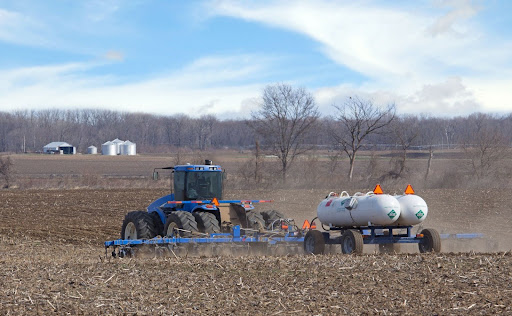
Fertilizer application and management can be a critical component of your CI score. (Photo credit: Adobe Stock)
So how does a producer prepare for the potential impact of 45Z and CI scoring for their farming operation? Good record keeping is essential. Detailed records of fertilizer management (rate, timing, source, and use of stabilizers), as well as tillage type and frequency, are imperative for accurate CI accounting and any potential auditing requirements. Sound nutrient management to improve fertilizer nitrogen use efficiency and reduce potential nitrous oxide emissions can also improve CI score. Use of practices that may offer soil health benefits, such as reduced tillage and cover crops, can lower CI score but should be evaluated for potential yield impacts with on-farm strip trials, as yield also contributes to CI score.
USDA deliberations are ongoing to finalize models that will be used to calculate CI scores, to decide appropriate chain of custody methodology to track corn grain from farm to facility, and to clarify how CI outcomes will ultimately translate into farmer compensation.
Farmers interested in employing soil health strategies are encouraged to consult ISAP’s Soil Health Guidebook and explore the FIND tool to find and compare financial incentive programs.
For up to date information regarding 45Z or carbon intensity scoring, check out Iowa Corn Growers Association.
