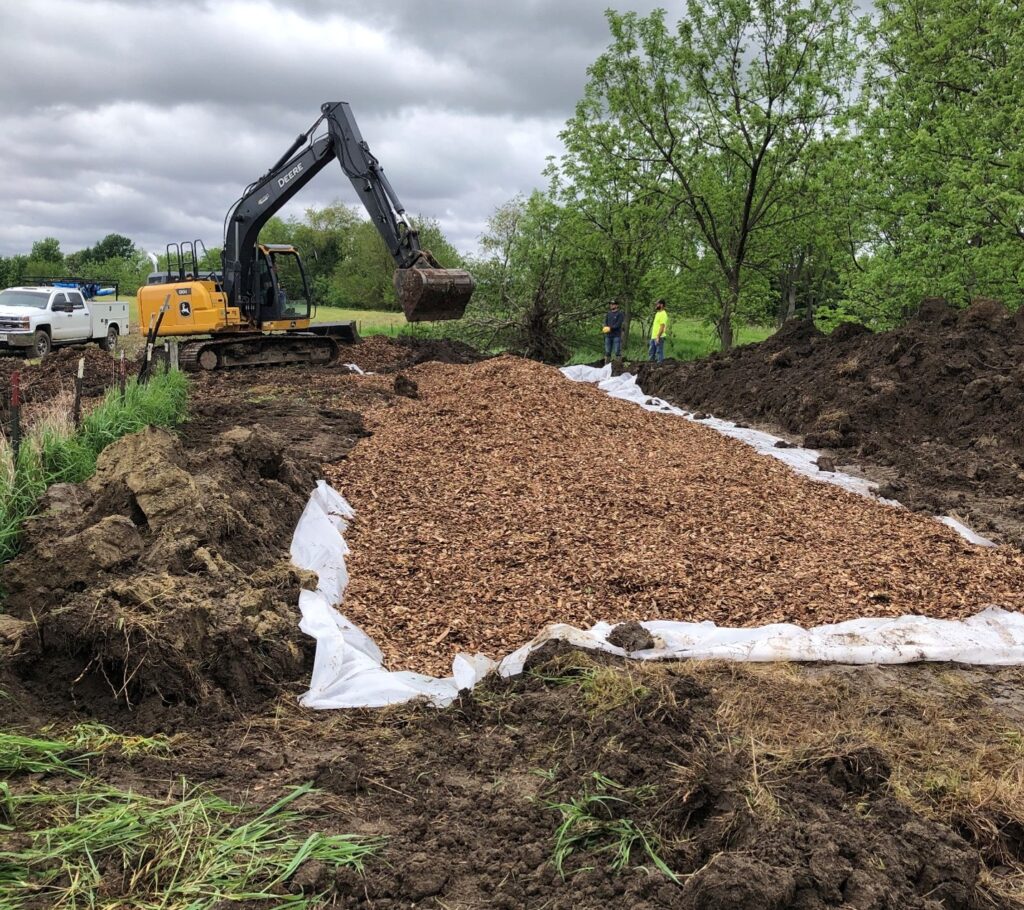
The Illinois Nutrient Loss Reduction Strategy (NLRS) sets ambitious goals to reduce nitrogen and phosphorus losses from point and nonpoint sources by 45%. Achieving those goals will require conservation practices that deliver measurable water quality benefits across Illinois landscapes, year after year. During ISAP’s November ICON webinar, Dr. Chris Hay, PE, of Hay Water Solutions explored how bioreactors and saturated buffers contribute to nutrient reduction efforts. In his presentation, Maintaining the Edge: Making Every Pound Count from Bioreactors and Saturated Buffers, Hay examined a new approach for estimating practice performance and shared practical lessons for keeping these systems functioning as intended over the long term.
Performance: Percent vs. Pounds
When discussing nutrient reduction, percentages often dominate the conversation. We regularly describe practices by the percentage of nitrate they remove and measure progress as a percentage reduction from a baseline. Improvements in water quality, though, are ultimately achieved one pound at a time. As Hay noted during the webinar, statewide nutrient reduction goals in Illinois, Iowa, and other states translate into millions of pounds of nitrogen that must be kept out of rivers and streams each year.
That perspective raises an important question: how should we measure the contribution of individual practices? Bioreactors are commonly credited using average nutrient reduction values (25% in Illinois), an approach that provides consistency for statewide and regional accounting. At the field scale, however, no two sites are exactly alike. Drainage area, incoming nitrate loads, and practice design can all influence performance.
Hay discussed how these differences shape our understanding of practice outcomes and why researchers continue to explore ways to better estimate nutrient reductions. Looking at both percentage reduction and pounds removed can provide a more complete picture of impact. Percentage reduction describes how efficiently a practice treats the water it receives, while pounds removed help quantify its contribution to broader nutrient reduction goals. Together, these measures can help inform decisions about project siting, design, and conservation investments.
Understanding drivers of nutrient reduction
One of the central themes of the presentation was that bioreactors are designed to treat a portion of drainage water, not every gallon that leaves a field. Because total nitrate removal depends on how incoming flow, nitrate concentration, and bioreactor sizing interact, sites with higher nitrate loads or larger drainage areas can sometimes remove more total pounds of nitrogen even when treatment efficiency is lower. Understanding these dynamics helps practitioners weigh tradeoffs between treatment efficiency and total pounds removed when evaluating potential practice sites.
Management matters
One of Hay’s clearest messages was that installation is only part of the equation. Even a well-designed practice must be properly managed to deliver long-term water quality benefits.
Bioreactors and saturated buffers typically require little routine maintenance, but control structures play a critical role in ensuring systems operate as intended. Hay emphasized the importance of knowing control structure settings and periodically checking sites, particularly where seasonal adjustments may be needed. He also highlighted several resources available through the Conservation Drainage Network, including guidance documents, videos, stoplog calculators, and field tools that help landowners, contractors, and conservation professionals maintain practice performance over time.
Bioreactors and saturated buffers remain important tools for reducing nitrate losses from tile-drained agricultural landscapes. Hay’s webinar offers a useful overview of both the science behind nutrient reduction estimates and the practical considerations that support long-term performance. His presentation provides valuable insights into how these practices work, how their benefits are measured, and how proper management helps ensure every pound counts.
The November webinar can be viewed on ISAP’s YouTube channel. If you are interested in presenting, sharing a topic suggestion, or other feedback about the Illinois Conservation On-Farm Network , please send an email to hello@ilsustainableag.org.