
What influences whether conservation practices are adopted, and what does that mean for reaching nutrient loss reduction goals? This April 2026, the Illinois Sustainable Ag Partnership Science Committee was joined by Chris Morris, rural sociologist and postdoctoral researcher at Iowa State University and soon-to-be faculty at Kansas State University, to discuss how social science can help answer these questions. Drawing from his research and 15 years of prior experience working with USDA NRCS, he focuses on the factors that influence farmer decision-making and conservation practice adoption.
Understanding the Gap in Adoption
Across the Midwest, adoption of conservation practices like cover crops, wetlands, and bioreactors continues to fall short of long-term goals. At current rates, it could take decades, or longer, to reach some of these targets.
From a social science perspective, this gap is tied to how decisions are made. According to Fishburn and Ajzen’s Reasoned Action Approach (2010), behavior is driven by intention, which is influenced by attitudes toward a practice, perceptions of what others are doing, and whether someone feels capable of implementing it. These are shaped by a wide range of background factors, making conservation decisions complex and highly individual.
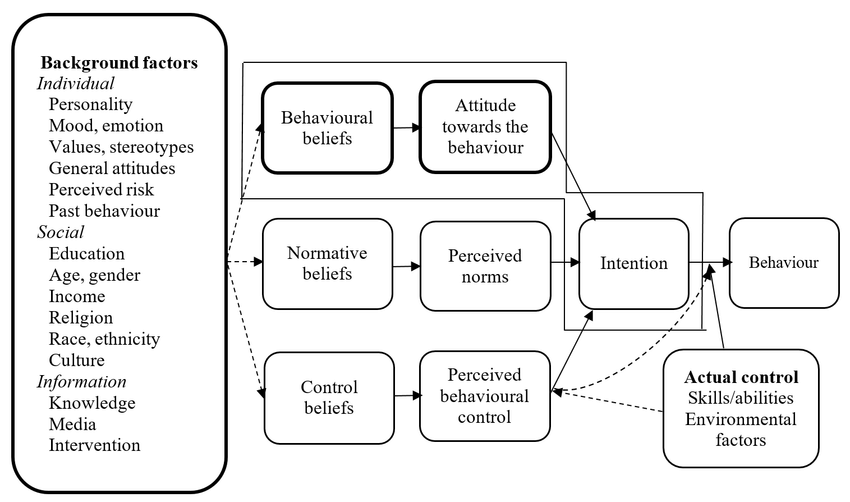
The decision to adopt a conservation practice is based on multiple factors, including personal attitudes and values, social influences, and having knowledge and confidence to make a change. / credit: Reasoned Action Approach (Fishbein and Ajzen, 2010; https://doi.org/10.4324/9780203838020)
What Research Shows About Adoption
Using data from the Iowa Farm and Rural Life Poll, a long-running survey of farmers, Morris examined how conservation plans relate to practice adoption. Contrary to expectations, having a conservation plan was a significant predictor for only a small number of practices.
Instead, one of the most consistent predictors of adoption was the number of times a farmer visited a USDA field office for conservation-related purposes. More frequent visits were associated with the adoption of practices like cover crops, no-till, nitrogen stabilizers, buffers, and terraces. This finding highlights that relationship building is one of the strongest drivers of conservation practice adoption.
Insights from Conservation Practitioners
To better understand what works for conservation practitioners, Morris also shared results from a Conservation Practitioner Poll conducted across the Upper Mississippi River Basin.
When asked about effective ways to begin working with farmers, practitioners identified:
- Introductions from trusted farmers
- Introductions from trusted conservation professionals
- Attending meetings where farmers and landowners are already present
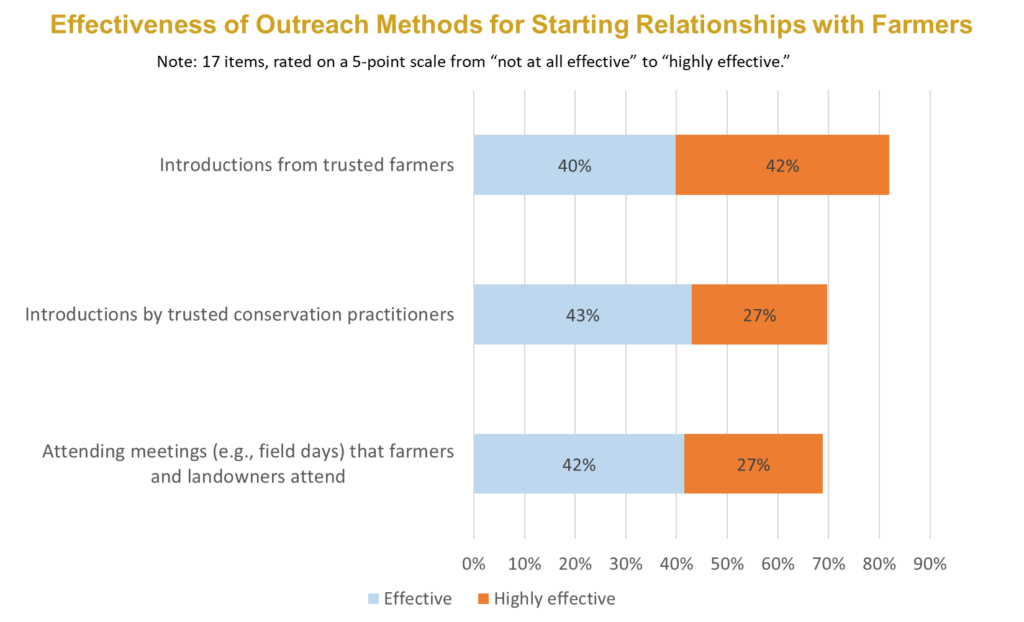
Building relationships with farmers is an important step in supporting conservation practice adoption, and one of the most effective ways to begin building relationships is through an introduction from another trusted farmer. // credit: Conservation Practitioner Poll – Chris Morris, Iowa State University.
For getting conservation practices “on the ground,” the most effective approaches included:
- Building long-term relationships through multiple interactions over time
- Working face-to-face with farmers, especially in the field
- Cost-share programs
- In-person field days and workshops
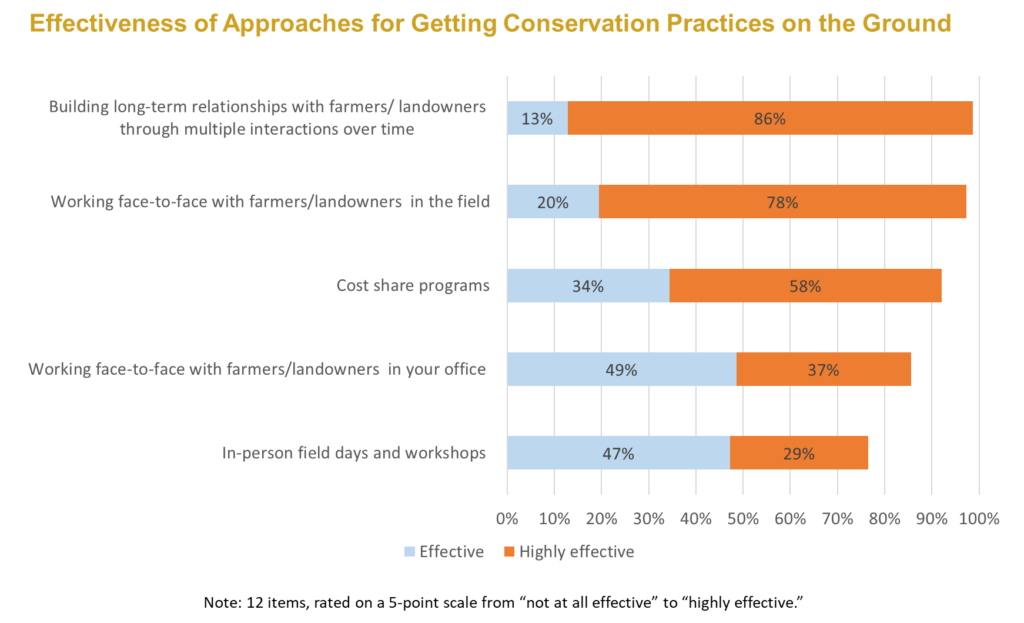
Multiple interactions with farmers, and specifically face-to-face interactions, are critical to building and maintaining long-term relationships that support the adoption of conservation practices. // credit: Conservation Practitioner Poll – Chris Morris, Iowa State University.
At the same time, practitioners reported barriers that limit their ability to focus on these activities, including excessive paperwork, changing program requirements, technology challenges, and limited time and staffing capacity. Many practitioners noted that while relationship-building is the most effective part of their work, it is also the part they spend the least time doing due to these constraints.
Barriers to Adoption
Farmers face a range of barriers when considering conservation practices. These include potential yield impacts, timing within existing systems, costs, and uncertainty about whether a practice will work on their operation. Farmers are also operating in a high-risk environment shaped by weather variability, market fluctuations, and financial pressures. Morris discussed the role of stress and trauma in farming communities, including physical, economic, and social pressures that can affect decision-making. These factors can contribute to risk aversion and influence whether new practices are adopted. He also noted that past experiences, such as the 1980s farm crisis, can continue to influence how farmers think about spending and risk.
Building Trust and Framing Conservation Messages
Across both research and practitioner experience, trust consistently emerged as a key factor in conservation adoption. Farmer-to-farmer connections, whether through field days, workshops, or informal conversations, can help farmers build confidence in new practices. Morris emphasized the importance of meeting farmers where they are and understanding their goals, values, and what they are trying to accomplish in their operation. Addressing their concerns as valid, rather than dismissing them, is critical to building that relationship of trust.
He also highlighted the importance of how conservation practices are framed in those conversations. Communicating how conservation practices can help mitigate risk can better align with how farmers make decisions under uncertainty. Rather than presenting conservation as a whole system change all at once, breaking it down into smaller, manageable steps over time can help farmers feel like it is something they can actually do. Morris also emphasized connecting farmers to other farmers, so they can learn what has worked, what has not, and how others have worked through challenges on their own operations.
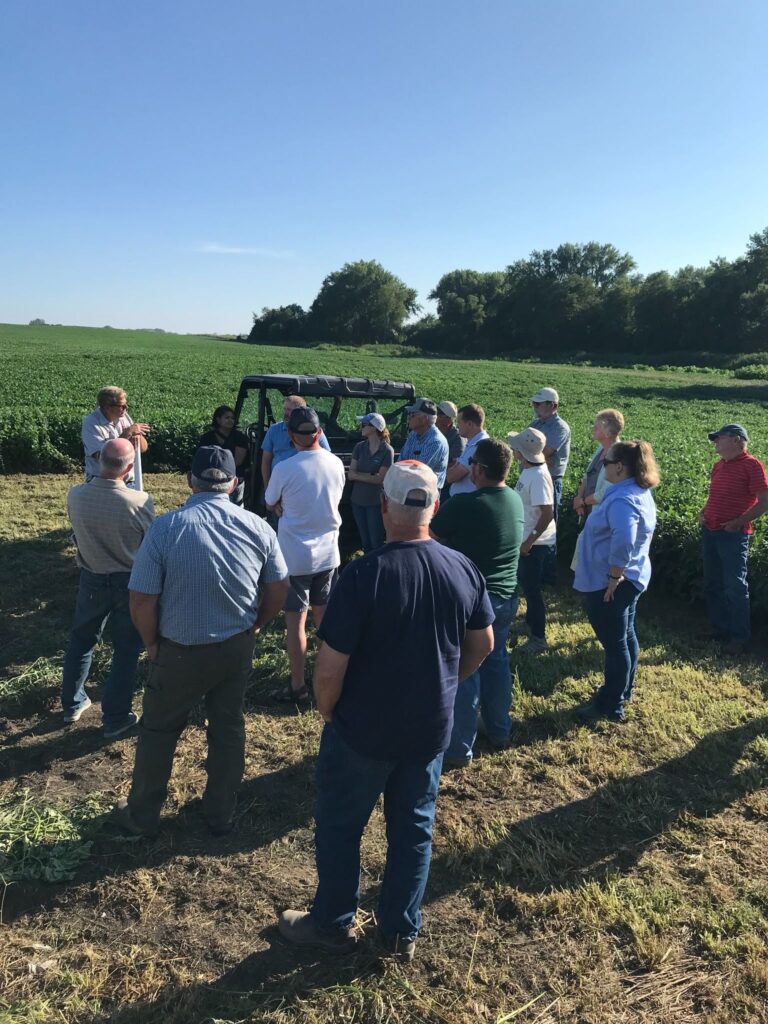
Connecting farmers with other farmers is an effective way to share learning and improve the likelihood of adopting new practices. / credit: Jean Brokish, American Farmland Trust
As Illinois continues working toward nutrient loss reduction goals, the research shared by Morris indicates programs could benefit from prioritizing relationship building between conservation practitioners and farmers to unlock greater practice adoption.
Additional Resources:
Conservation plans and soil and water conservation practice use: Evidence from Iowa
Conservation Practitioner Poll 2024 Summary Report
Illinois Conservation On-Farm Network (ICON)
