
Expanding the adoption of edge of field (EoF) conservation drainage practices, including saturated buffers, bioreactors, drainage water management systems, and constructed wetlands, depends heavily on having trained professionals who can design and deliver them to interested landowners. To help build this crucial technical capacity, ISAP hosted a two-day workshop, Modern Approaches to Conservation Drainage Design, in Danville, IL in early May. The training was designed to provide engineers, surveyors, drainage officials, and contractors from Illinois and Indiana with practical skills for siting and designing effective water quality practices.
Co-facilitated by water management experts Dr. Chris Hay (Hay Water Solutions) and Dr. Gary Sands (University of Minnesota), the workshop combined classroom-style instruction with hands-on application. Participants began day one exploring water quality challenges linked to nutrient loss in tile-drained systems and reviewed fundamental drainage principles. The training then shifted to practice-specific modules on drainage water management, saturated buffers, and bioreactors, where attendees worked through design exercises using real Midwest examples with site data and spreadsheet planning tools.
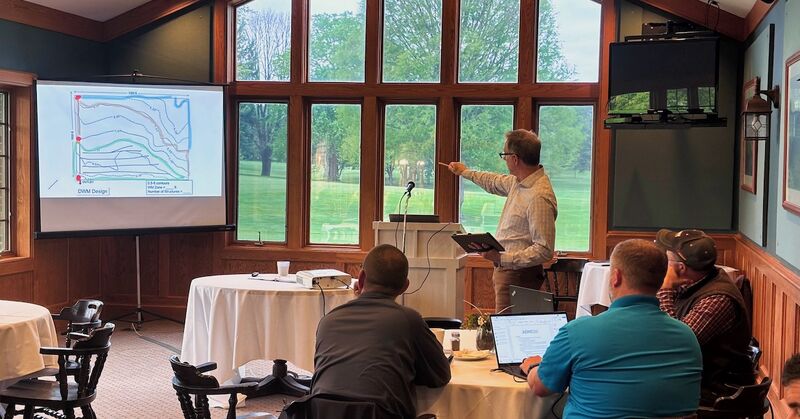
Dr. Gary Sands illustrates how to create water management zones within a tile-drained field. (Photo by Chris Hay)
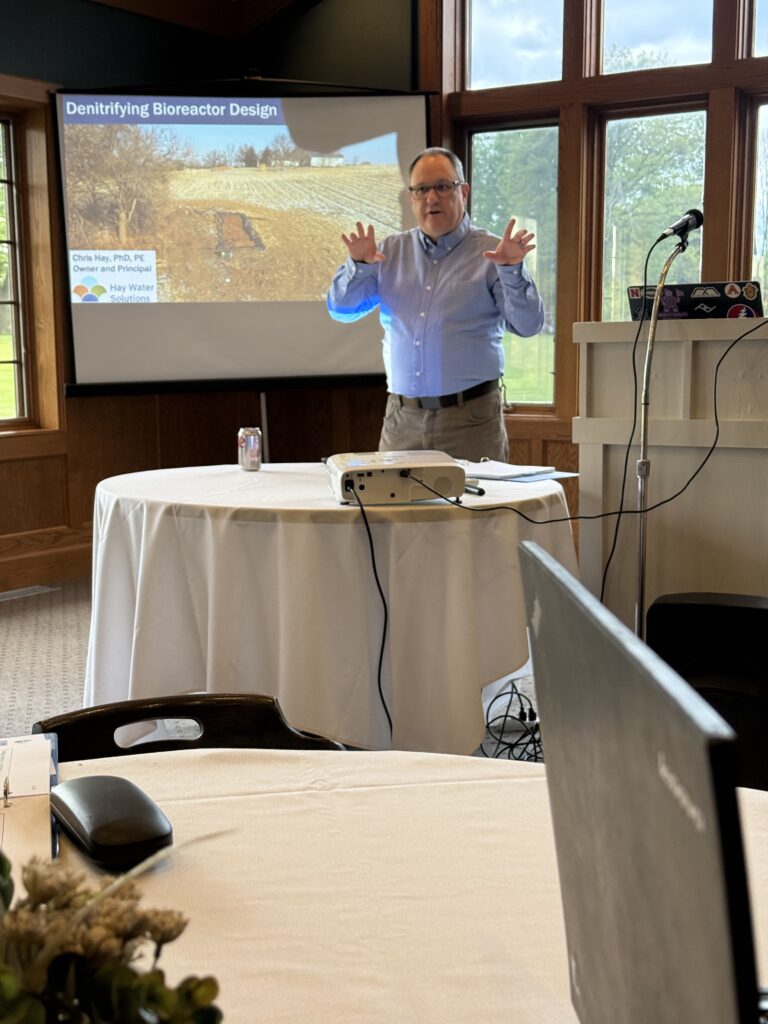
Dr. Chris Hay walks through denitrifying bioreactor design during a hands-on session, highlighting how these systems reduce nitrate loss from tile drainage. (Photo by Keegan Kult)
On the second day, Illinois NRCS staff discussed the Technical Service Provider (TSP) program and certification process. TSPs provide valuable services that benefit both NRCS and landowners; they evaluate site conditions, complete practice designs, and ensure that practices are properly implemented, effective, and aligned with program requirements and farmer needs. An increase in the number of certified TSPs for conservation drainage practices could reduce bottlenecks in planning and design, helping projects move forward more efficiently.
The workshop concluded with a look to the future, focusing on opportunities to accelerate adoption. Participants explored tools like the Ag Conservation Planning Framework (ACPF) for site identification and discussed alternative delivery approaches such as Iowa’s Batch & Build model. Feedback emphasized the value of the workshop’s hands-on format, but also highlighted a persistent challenge: limited farmer demand for EoF practices. These insights underscore how barriers to adoption and implementation are closely connected and point to the need for ISAP and its partners to focus both on growing demand for EoF practices through outreach, education, and incentives and on expanding the technical capacity needed to support broader implementation.
The Modern Approaches to Conservation Drainage Design workshop was sponsored by ISAP, the Ag Drainage Management Coalition, and The Nature Conservancy through an Achieving Conservation Through Targeted Information, Outreach & Networking (ACTION) Program grant from the Foundation for Food & Agriculture Research and the Walton Family Foundation.
