
Perennial agriculture is not as straightforward as annual row crop commodities, especially in Illinois, but can be an innovative approach to landscape design that has the ability to provide benefits to the farmer and the environment. Before getting started with planting perennials on your farm, there are certainly going to be lots of questions. Some of these questions may be what are the benefits of perennials, what are the specific crops of focus when discussing perennial agriculture, how do you incorporate these crops into your operation, what does the end-user market look like in 2025 and beyond, and how robust is the support network for folks who are interested in exploring perennials. These questions were discussed as the ISAP Science Committee hosted a panel of experts to talk about perennial agriculture back in October, namely Dr. Emily Heaton, Professor of Crop Sciences at University of Illinois, Dr. D.K. Lee, Professor of Agronomy at University of Illinois, Marlee Giacometti, Program Specialist at American Farmland Trust, and Dr. Nate Lawrence, an ecosystem scientist at Savanna Institute.
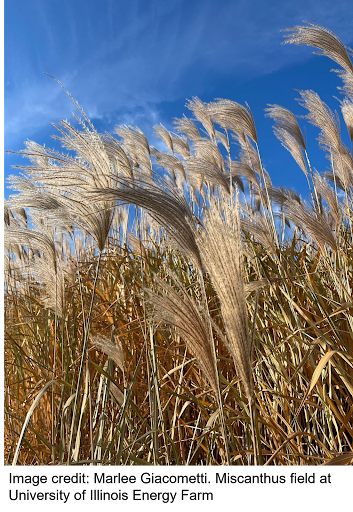
For some clarification, perennial agriculture is described as the cultivation of crop species that live longer than two years, without the need for replanting each year. Perennial agriculture is an umbrella term that includes a variety of systems that can stand alone or be integrated with each other or existing annual crop systems. Examples include wildlife plantings, native prairie, pasture, perennial biomass crops, and perennial tree crops such as fruits, nuts, or timber. Agroforestry is another broad term within perennial agriculture that encompasses a range of practices that specifically integrate trees, from silvopasture and alley cropping to windbreaks and riparian buffers. Perennial agricultural systems emphasize improvements to ecosystem services such as building soil, filtering water, recycling nutrients, cleaning air, protecting capital assets (land, energy investments, infrastructure), or providing habitat for wildlife in addition to a marketable product. One way to make perennials work for you is to start by assessing areas of your landscape that are under-productive or unprofitable, as research has shown that integrating perennials into unprofitable parts of fields can meaningfully increase profitability and reduce nitrate losses. Targeting marginal land for conversion to perennial agricultural systems can allow production of marketable crops while maintaining conservation of that land. Maintaining highly productive land for traditional annual row crops while strategically transitioning highly erodible land or riparian land into perennial production can offer benefits to the farmer and environment. Integrating livestock is another way for people who are curious about perennial crops, as there is a wealth of support and information on using pasture to raise livestock.
So, thinking of perennials and their benefits, it is important to parse out the categories that these crops fall under. Recommended for Illinois include forage crops, such as hay, sorghum/sudan grass, and alfalfa, pasture crops, such as major pasture grasses, legumes, and some natives, biomass crops like switchgrass and miscanthus, wood crops including walnut, hickory, and oak, fruit/nut crops, such as hazelnut, chestnut, persimmon, walnut, elderberry for grain crops like Kernza and perennial sorghum.
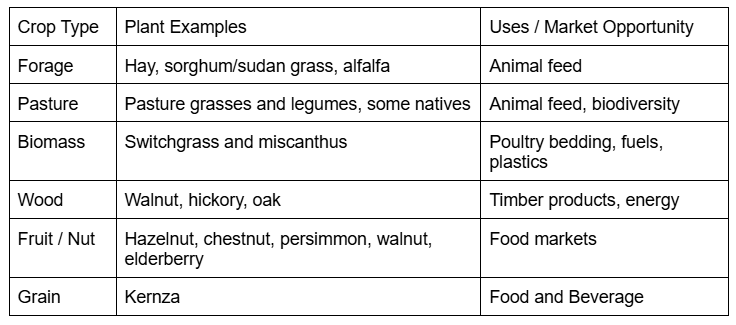
While some of the markets are straight-forward for food-related operations, biomass crops have a diverse and expanding market that requires innovation and cross-discipline collaboration to materialize their use. The U.S. Department of Energy’s Billion-Ton Report series finds that 1.1-1.5B tons of biomass can be sustainably produced domestically from sources including wastes, forestry, agriculture, and algae, tripling the bioenergy production while still meeting demands for food, feed, fiber, and conventional forest products. Specific to agriculture, the report estimates that approximately 9% of US agricultural land (~76M acres) dedicated to energy crops could produce approximately 350-650M tons of biomass, depending on price point and the rate that the biomass market matures.
Currently, the primary end uses for biomass crops includes poultry bedding, biomass energy as a replacement for coal, and food packaging or pulp-based consumer products broadly known as ‘bio-based products’. More nascent markets that are working to incorporate biomass products are the Renewable Natural Gas (RNG) and Sustainable Aviation Fuel (SAF) markets as well as developing markets for biomass-based building materials. Further down the road, there is potential to see biomass crops being integrated into pet care products such as litter, biochemicals, and food ingredients or additives, such as anthocyanins from miscanthus. Through these various markets, industries, and harvest windows, perennial crops can offer diversified, layered income streams that work for a producer.
Technical assistance in the form of one-on-one conversations or full-farm management plans from organizations such as American Farmland Trust can help support producers interested in transitioning acres into perennial agriculture for end uses such as biomass energy or other products. Additionally, SUPERBEEST, a new decision-making tool developed by Argonne National Laboratory, can be used by farmers, landowners, biorefinery planners as well as watershed managers to help identify marginal farmland optimal for bioenergy conversion and assess ecosystem services generation.
Demonstrating ecosystem services that can be monetized may be necessary for perennial agriculture to provide higher profit margins for growers. Analyzing the benefit of perennial agricultural systems on water quality, greenhouse gas mitigation, and soil health could offer avenues for these growers. In ongoing research performed by Savanna Institute where innovative techniques are being used to quantify carbon in biomass of the hybrid hazelnut, conservative estimates for the carbon sequestration co-benefit come in at around 1 metric ton of CO2e per acre per year. Identifying the conservation benefits and their corresponding economic benefit to society from the local to national level is an important part of this work. Developing the perennial agriculture industry through research, innovation, processing, analysis, and assistance will provide growers or landowners alternative and diversified opportunities for their operation.
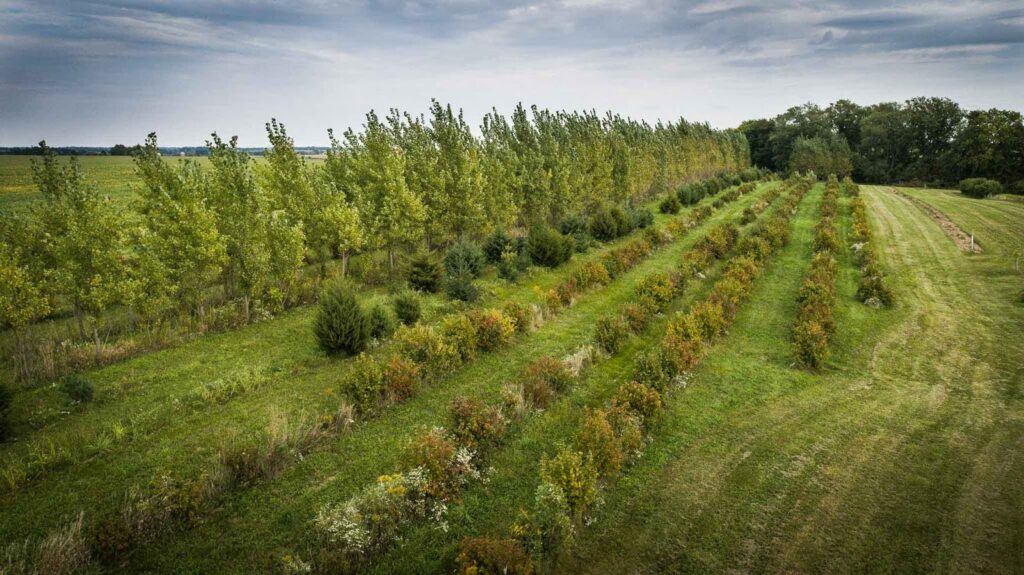
Windbreaks at Illinois Demo Farm. Photo courtesy of Savanna Institute.
