On November 12, the Illinois Conservation On-Farm Network (ICON) hosted Isaac Ferrie of Crop Tech Consulting and Ben Reinhart of Ecosystem Services Exchange for a discussion on conservation drainage practices that deliver multiple benefits for producers. While several options exist for tile-drained landscapes, such as saturated buffers and bioreactors, the spotlight for this webinar was on controlled drainage, also known as drainage water management.
What is Drainage Water Management?
Drainage water management involves installing a water control structure on the drainage main, allowing farmers to raise or lower the water table throughout the year. This flexibility means water can be held back during the non-growing season, as well as during critical growth stages, reducing total drainage volume and nutrient loss while also supporting crop production. In short, it’s not just a nutrient management tool – it’s a water management strategy that can boost yields when conditions turn dry. There are an estimated 10,000,000 acres suitable for drainage water management in Illinois!
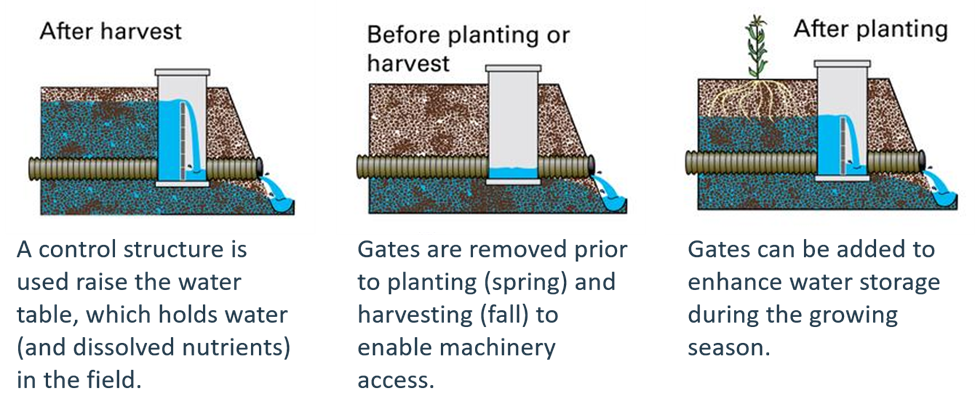
Typical annual management of a water control structure. Graphic courtesy of Purdue University.
Why Drainage Matters
Farmers install drainage to improve field trafficability, reduce soil saturation, and protect crop health. Conventional drainage systems are designed to remove water quickly, but this can leave fields vulnerable during mid- to late-season dry spells. The option to manage drainage structures changes that equation by giving farmers the capability to keep some water in the field, giving crops access to moisture when rainfall is unpredictable.
Key Insights from On-Farm Research
Ferrie shared results from the McLaughlin-Dooley plot, a long-term study in central Illinois:
- Deeper Root Activity: Controlled drainage plots showed greater root activity and water uptake at 3–4 feet of soil depth, compared to shallow rooting in conventional systems. This deeper penetration of crop roots indicates greater potential for water (and perhaps nutrient) uptake.
- Better Moisture Capture: During dry spells, controlled drainage plots reached adequate soil moisture with fewer rain events—critical when the timing of the next rain is unknown. Soil cracks and preferential flow were more pronounced in the conventionally drained plots and were the main pathway for water loss to tile.
- Yield Advantage: Over nine years, controlled drainage averaged +7.3 bushels/acre in corn (5 years of data) and +3.9 bushels/acre in soybeans (four years of data).
- Automation is a Game-Changer: New technology allows remote monitoring and gate adjustments, reducing labor and improving precision.
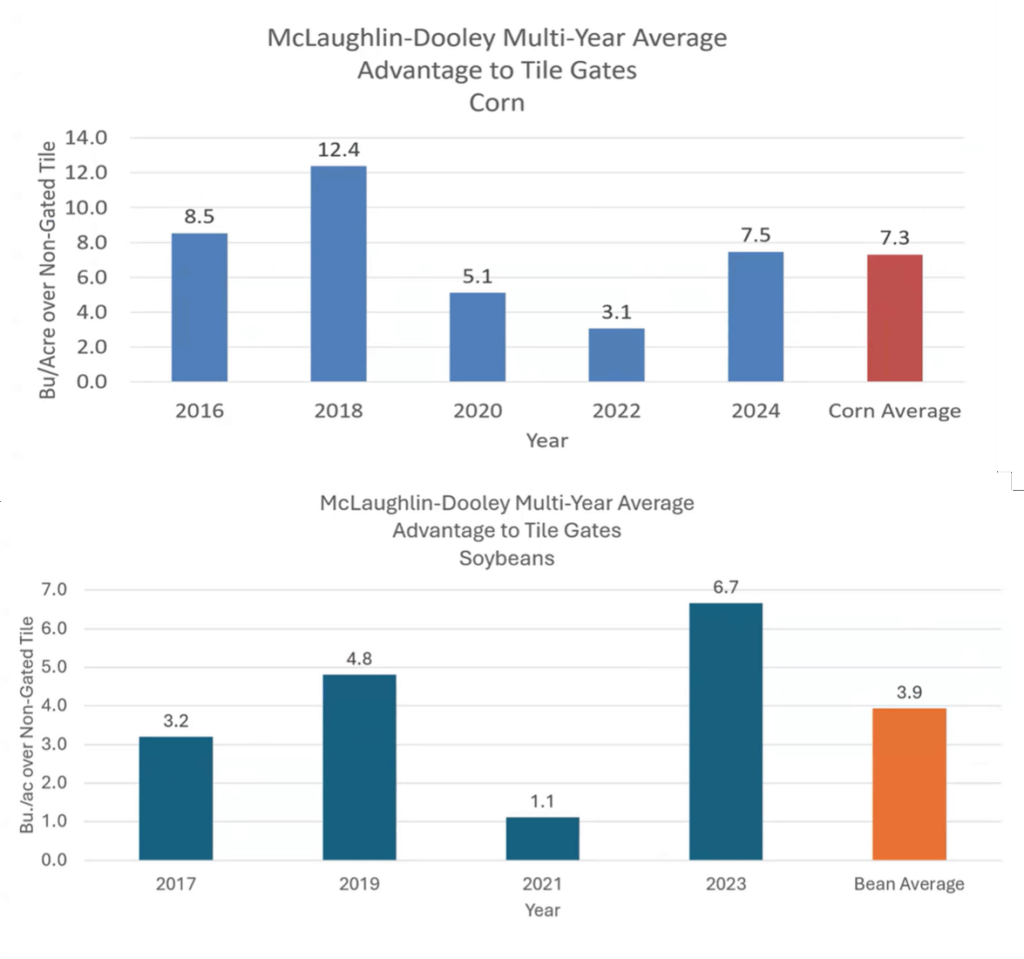
Across treatments with 30-, 60-, and 120-foot tile-drain spacing, addition of drainage water management has resulted in a 7.3 bushel/acre yield bump for corn over five years of measurement. For soybeans, managing drainage provided a 3.9 bushel/acre yield increase over four years of data collection.
Ferrie compared the concept to a sponge: a dry sponge absorbs little water when dunked quickly, but given time, it soaks up plenty. Controlled drainage gives soil that “soak time,” ensuring crops have water when they need it most.
Scaling Up Conservation Drainage
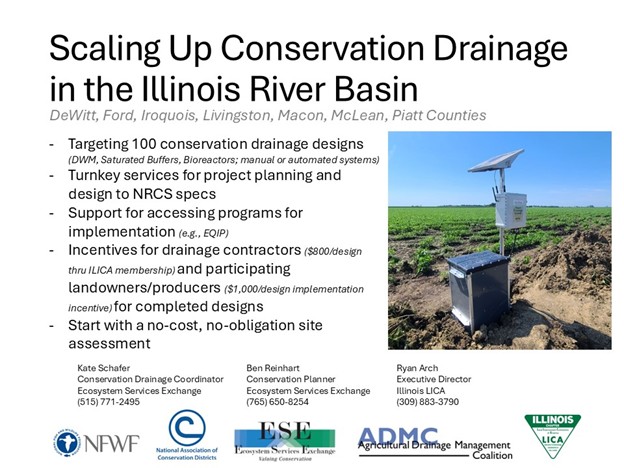
Following Ferrie’s presentation, Ben Reinhart highlighted a new initiative to accelerate adoption of practices like controlled drainage, saturated buffers, and bioreactors across seven Illinois counties (DeWitt, Ford, Iroquois, Livingston, Macon, McLean, and Piatt). The project offers free site assessments, design support, and incentives for landowners and contractors who participate. The collaborative effort includes two ISAP members – IL Land Improvement Contractors Association and the Ag Drainage Management Coalition. It aims to deliver 100 conservation drainage designs and to support farmers and landowners in working with state and federal agencies and other funders to move those projects from design to implementation – a big step toward improving water management and reducing nutrient loss in Illinois.
The November webinar can be viewed on ISAP’s YouTube channel. ICON will meet again on December 10, 2025. to talk about how conservation professionals can improve their methods of communicating edge-of-field practices to farmers. Register today and join us! If you are interested in presenting, sharing a topic suggestion, or other feedback about the Illinois Conservation On-Farm Network , please send an email to hello@ilsustainableag.org.
