
The Illinois Sustainable Ag Partnership (ISAP) Policy Committee recently hosted a webinar reviewing major agricultural and conservation policy developments from the 2026 Illinois legislative session. Representatives from ISAP member organizations shared updates on legislation, funding initiatives, and policy discussions that could impact Illinois farmers, landowners, conservation professionals, and rural communities.
The webinar provided a timely look at legislative efforts important to ISAP member organizations.
Estate Tax Reform
Illinois Farm Bureau
Chris Davis provided an update on ongoing efforts to reform Illinois’ estate tax system and reduce barriers to farm succession planning. The discussion focused on the challenges some farm families face when transferring farmland and agricultural businesses to the next generation. Participants noted that rising land values can complicate long-term transition planning and emphasized the importance of policies that help preserve working farmland, support family-owned operations, and keep agricultural land in production. While major changes did not advance during the legislative session, the issue remains a priority for many agricultural and conservation stakeholders.
Soil and Water Conservation District Funding
Association of Illinois Soil & Water Conservation Districts
Eliot Clay discussed the critical role Soil and Water Conservation Districts (SWCDs) play in conservation delivery across Illinois. District staff provide technical assistance, conservation planning, education, and support for farmers implementing conservation practices. Participants discussed the increasing demand for conservation services, and the challenges districts face when resources do not keep pace with workload. The conversation reinforced the importance of maintaining local conservation capacity and ensuring farmers have access to trusted, on-the-ground assistance as conservation programs continue to expand. Advocates failed to pass new funding mechanisms and or secure additional funding this session. However, AISWCD made headway in coalition building to continue the effort during veto or lame duck sessions.
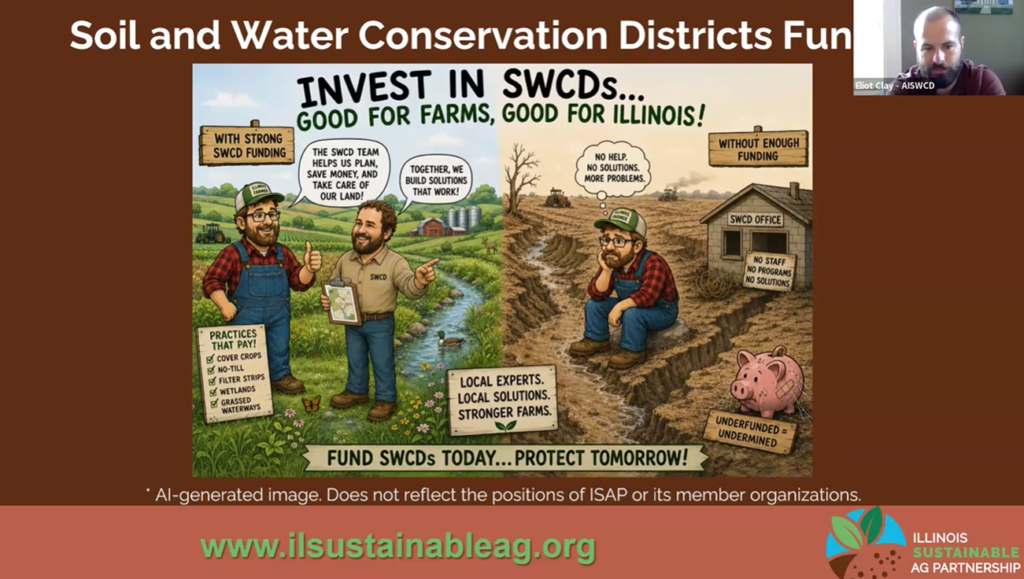
Eliot Clay, Executive Director of the Association of Illinois Soil & Water Conservation Districts (AISWCD) discusses funding outcomes of the 2026 legislative session.
Fall Covers for Spring Savings
American Farmland Trust
Claire Shipp provided an update on the Fall Covers for Spring Savings initiative, a proposal designed to encourage cover crop adoption through state-supported incentives. The program has been around for many years and has a history of being underfunded and oversubscribed. During the discussion, participants reviewed the legislative effort, funding request, and continued interest from conservation partners. While program funding remained flat this session, supporters remain engaged and continue working to build awareness and support for future opportunities.
Farmer Tax Benefit Act
American Farmland Trust
Claire Shipp also led a discussion on the Farmer Tax Benefit Act (FTBA), legislation aimed at encouraging conservation-minded farmland transitions through targeted tax incentives. The proposal would create incentives for landowners considering putting farmland into agriculture easements. Claire reviewed advocacy efforts surrounding the bill and discussed the broad coalition of organizations that supported the proposal. Although the legislation did not advance during the session, participants noted continued interest in refining the concept and building support among policymakers and stakeholders.
Low Carbon Fuel Standard
Illinois Soybean Association
David Kubik provided an overview of discussions surrounding a potential Low Carbon Fuel Standard (LCFS) in Illinois. Participants reviewed how LCFS programs function by creating incentives for lower-carbon transportation fuels and discussed the role renewable fuels could play in helping meet future carbon reduction goals. The conversation highlighted potential opportunities for Illinois agriculture, biofuels producers, and rural communities while acknowledging that policy discussions are still evolving. Stakeholder engagement and education were identified as important components of any future LCFS conversation. This legislation has matured over the past few years and is perceived as likely to move next legislative session.
Wetlands Protection Act
Illinois Corn Growers
Jon Hurst provided an overview of discussions surrounding wetlands policy in Illinois. The conversation focused on the challenge of balancing environmental protection with practical implementation and regulatory clarity. Participants discussed approaches used in other states and explored how policymakers can protect valuable wetland resources while ensuring regulations remain understandable and workable for landowners. Audience questions highlighted the importance of stakeholder engagement and the need for continued dialogue among agricultural, conservation, and environmental interests as wetlands policy discussions continue.
Illinois Extension Funding
University of Illinois Extension
Carl Baker discussed the important role University of Illinois Extension plays in delivering research-based education, agricultural outreach, youth programming, and community engagement throughout the state. Participants reflected on recent efforts to secure additional support for Extension and expressed disappointment that funding proposals did not advance further during the legislative session. The discussion highlighted Extension’s impact on farmers, families, businesses, and communities, as well as the value of maintaining strong connections between university research and local education programs.
Other Topics Discussed
In addition to the featured policy updates, participants discussed several other issues affecting Illinois agriculture and conservation.
The group reviewed ongoing efforts to support beginning and emerging farmers, including grant programs, technical assistance opportunities, and initiatives designed to improve access to farmland. Participants discussed the importance of ensuring new farmers have access to resources needed to establish and grow successful operations.
Several participants highlighted the importance of communicating conservation successes more effectively, particularly through Illinois’ Nutrient Loss Reduction Strategy (NLRS). The discussion emphasized the role that farmers, conservation districts, commodity groups, and partner organizations play in advancing conservation practices and sharing those successes with policymakers and the public.
Looking Ahead
A consistent theme throughout the webinar was the importance of partnership. Speakers emphasized that meaningful progress often requires collaboration among farmers, conservation organizations, commodity groups, government agencies, universities, and policymakers.
This recap highlights only a portion of the discussion. To hear the full conversation, audience questions, and perspectives shared by ISAP member organizations, be sure to watch the webinar recording and review the presentation materials.
